


© SOLLYS DESIGN

Condo Renovation Singapore | Full Makeover for Japanese Lifestyle Homes
2025.03.12
Can Japanese Nationals Purchase Property in Singapore?
Many Japanese who relocate to Singapore for a short period choose to rent, but those planning to stay long-term may consider purchasing property in Singapore. Japanese nationals (who do not hold Singaporean citizenship or Permanent Residency) often ask, “Can we foreigners purchase a condominium?” The answer is yes, condominiums can be purchased by foreigners. However, the Additional Buyer’s Stamp Duty (ABSD) varies depending on whether the buyer is a Singaporean citizen, PR, or foreigner, with foreigners paying the highest rate. On the other hand, landed properties or government-subsidized Housing Development Board (HDB) flats are generally restricted to Singapore citizens or PR holders.
From an interior design perspective, there are three key benefits to purchasing a property:
① Full Renovation to Create Your Ideal Space
In a rental, major renovations often require landlord approval and may be restricted. Ownership allows complete freedom to design layouts and choose materials.
② Design Adapted to Lifestyle Changes
You can plan a home that accommodates changes in family composition or children’s growth, such as converting room functions or enhancing storage, ensuring long-term comfort and usability.
③ Built-in and Smart Features for Comfortable Living
Integrating built-in appliances (oven, fridge, dishwasher, air conditioning) and smart lighting or security systems makes the home visually cleaner, more convenient, and comfortable.
Project Example: Full Renovation of a Pre-owned Condo for a Japanese Perspective
This example showcases a 4-bedroom condominium purchased by a client in Singapore, for which we conducted a full renovation. Originally featuring classic interior and wall-to-wall wallpaper, the goal was to create a soft and welcoming environment that would nurture a child, making it feel like a “home” for the little one.
Interior Design Adjustments and Considerations

Here is a Before & After photo of the living room. The wooden beam on the ceiling visible in the After photo was custom-built. It was intentionally designed to balance structural beams above the far window and the lowered ceiling for the air-conditioning pipes on the left. Elements that could have limited the space were instead incorporated into the design, resulting in a cohesive and aesthetically pleasing outcome. The focal wall at the entrance and the TV area were also integrated with the ceiling and AC design, creating a harmonious space that reflects the client’s personality.
Water Area Design with Functionality in Mind
The kitchen and bathrooms were designed with Japanese lifestyle considerations. The bathtub in the original condo was set lower than the floor, which made it inconvenient for Japanese users. We renovated it to make the space more functional, providing a Japanese-style bathing experience.

After coordinating with the contractor to confirm the structure, the original bathtub area was filled and leveled, and a new bathtub was installed along with a wash area, which is essential for Japanese users. (Below is a 3D proposal image.)

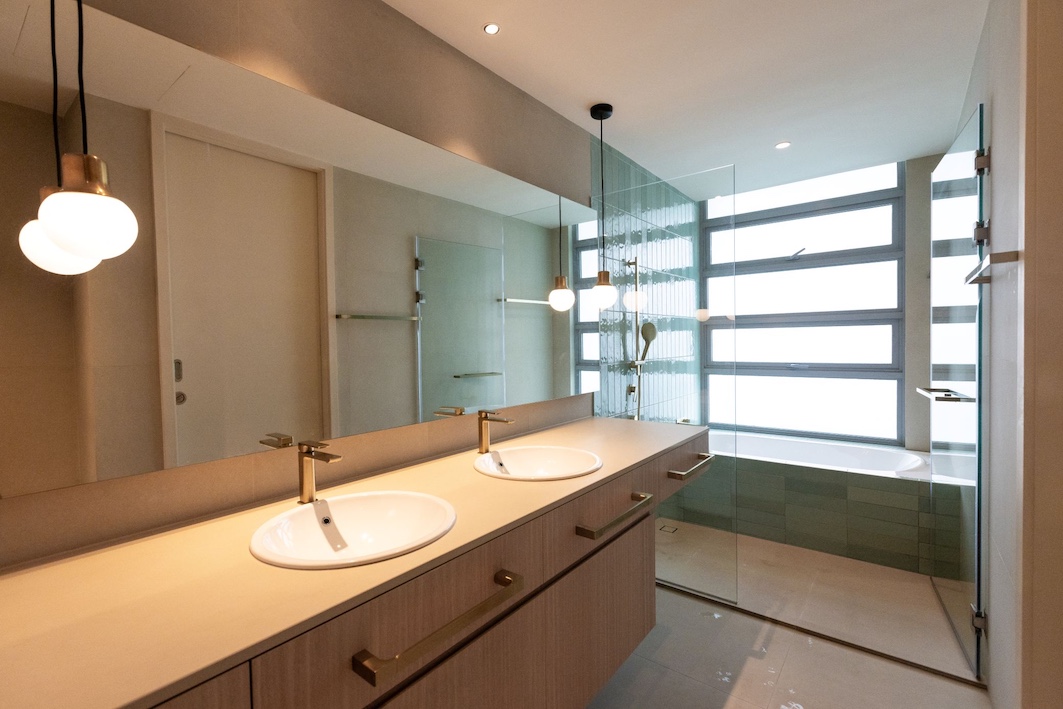
We installed TOTO washlets in the master and connected bathrooms, which are familiar to Japanese users but uncommon in Singapore. Soft green tiles were carefully laid, and brass fixtures from an Australian brand were added as accents.

The master bathroom was designed to reflect the wife’s preferences, including a stool at the counter for makeup and hair-drying space.

Custom Kitchen Storage
The old kitchen was outdated and inconvenient, so it was completely renovated. While the layout remained mostly the same, storage sizes and configurations were customized to the client’s lifestyle.

A key feature is the marble countertop in the center. Instead of removing it (which would be costly), we incorporated pendant lighting and coordinated colors to connect it seamlessly with the Japandi-style design.
*Japandi style combines “Japan” + “Scandi(navian)”—merging Japanese simplicity and Nordic warmth for a cozy, minimalist yet inviting interior.

Reconfiguring the Original Layout to Create a Sub-study
The master bedroom originally had partition walls and built-in furniture, all of which were removed to create storage and room layouts suited to the client’s lifestyle.


Behind the right curtain is a wall-length closet for easy access. The desk by the window was retained and refreshed with a new overlay, creating a sub-study and makeup space for the wife.
Child-Friendly Bedrooms for Family Interaction
 The door to the left of the TV was replaced with a sliding door to allow the child’s room behind it to be left open while monitoring the child at play.
 The kids’ room walls were painted bright yellow to encourage play. The floor was covered with wipeable Ryukyu tatami mats, adding Japanese elements, cushioning, and easy maintenance.
⚫︎ Additional project photos can be found here.
Summary
We provide interior design solutions that understand Japanese lifestyles, tailored to clients’ needs. At Sollys Design, we:
① Act as a liaison to ease communication with contractors,
② Introduce trustworthy contractors,
minimizing client burden and ensuring smooth construction. We do not always use the cheapest contractors in Singapore, but we prioritize reliable workmanship and aftercare. Renovation requires close communication and detailed design planning, making Sollys Design an excellent choice. Learn more here.
We also handle office and commercial renovations.

Recent Topic



Sollys Interior Design Pte. Ltd.
30 Petain Road Singapore 208099, Singapore, 208099